
Insight
·
From Market Access to Market Success: Understanding the Spot-Market Ecosystem
A guide for new entrants on the companies and roles that sit between direct market access and trading performance in the Dutch power system, and how the choices between them connect.

Olivier de Jonge
Summary
Getting access to a BRP or becoming one yourself is typically seen as the largest hurdle to trading.
The ecosystem runs from market access to market success: starting with a BRP, then the systems that let you see and steer your assets, then the forecasts that tell you what the market will do, then the parties that help you trade on it.
The parts are interconnected and the field is still evolving. A choice you make at the access stage, such as which BRP route you take, can constrain the options you have for other parts of the ecosystem.
Introduction
New market entrants we speak to often ask the same question: what does the step to direct market access require?
Knowing which companies operate in the short-term electricity ecosystem is only the start. To make sense of it, you also need to understand which roles exist, what each one does, and how they connect. These roles sit at different stages of the trading process and serve different purposes, and a choice you make about one role rarely stays contained to that role.
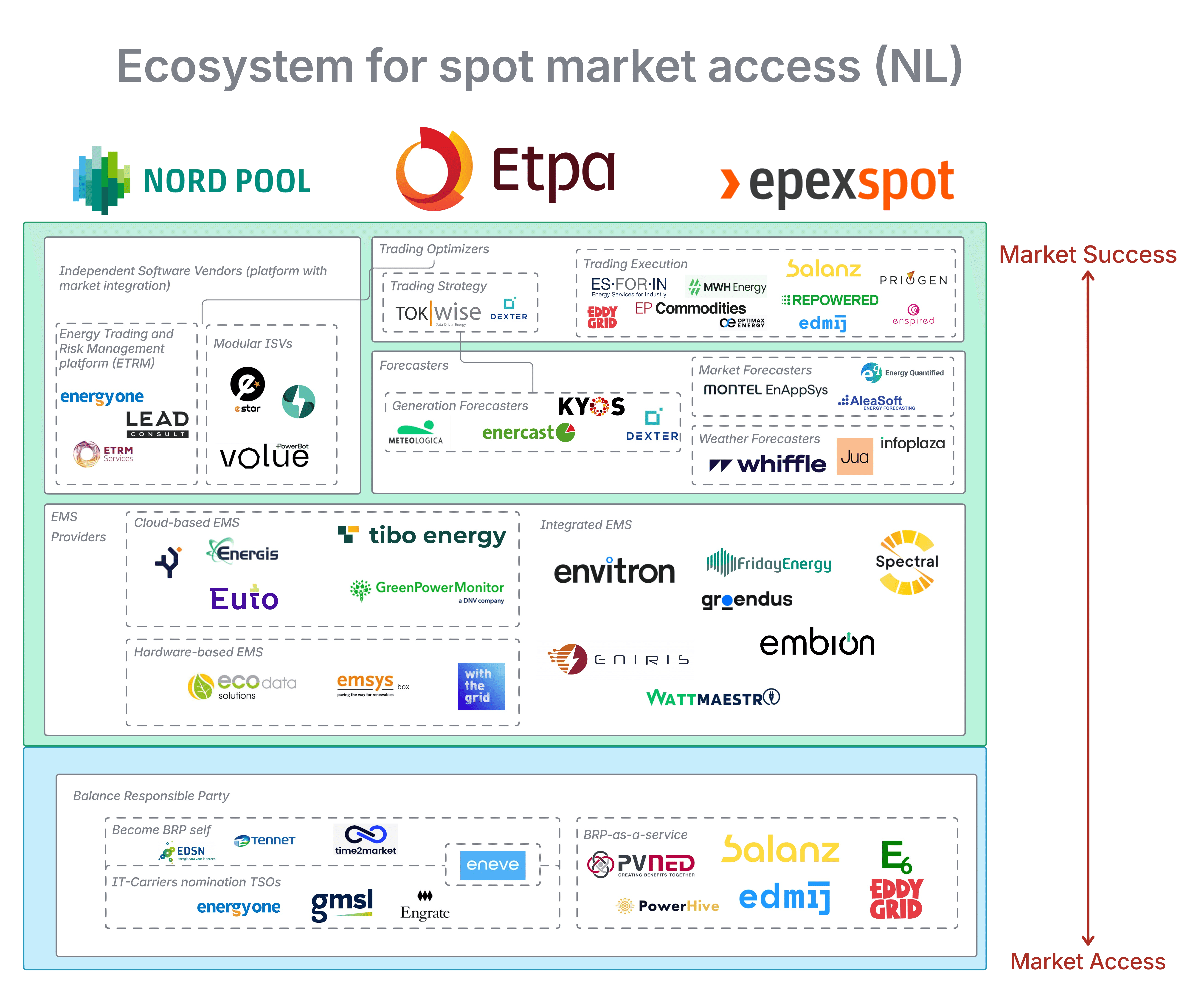
In this paper we go through the ecosystem from the bottom up, from market access, the point every participant has to pass through, to market success, where access turns into (improved) trading performance. Along the way we define each category and show where one decision shapes the next. The visual below is the map, and each section that follows explains a section.
Balance Responsible Party (Market Access)
To access the spot market, a participant must trade through a Balance Responsible Party (BRP). This is the point every participant passes through, and it is where the ecosystem journey begins. There are two ways to do it.
The first is to become your own BRP. Parties in this category help you take on the BRP role yourself, either through consulting or through IT solutions for submitting nominations to the Transmission System Operator (TSO). Nominations are the crux here. IT testing with the TSO is difficult, which is why a separate group of IT carriers specialise in getting those nomination flows live and (more importantly) stable. Several parties also offer imbalance settlement tools, so participants can financially settle any imbalances they incur.
The second is BRP-as-a-service. Parties in this category let you trade on the spot market under their BRP, and they handle imbalance settlement for you. In return, the service provider charges market access fees and may set limits on how fast you can trade, how much volume you can move, and which markets you can reach. We are seeing innovative new approaches with companies directly trading on our exchange while using a third party BRP.
This is the first fork on the road, and it does more than provide market access. Becoming your own BRP gives you full freedom together with the full operational burden of nominations and settlement. BRP-as-a-service reduces that burden but may constrain your trading speed, volume, or market reach. The decision between these two options also reaches further up the ecosystem than most new entrants expect, as we will see in the trading layer.
Energy Management Systems
Before you can trade well, you need to see and control the assets behind your position. Energy Management Systems (EMS) manage electricity flows at the asset level. Modern systems increasingly allow remote, automatic, and multi-asset management, for example solar charging a Battery Energy Storage System (BESS). Providers differ in how far they automate this, ranging from no asset steering to rule-based steering, to machine-learning-based steering.
On-site EMS providers control physical assets directly. They supply the hardware that interacts with the asset itself, commonly known as first-level SCADA (the direct control layer sitting on the asset).
Cloud-based EMS providers work one level up. They aggregate multiple assets, pool their data, and steer them collectively from a central platform, typically without localised hardware of their own. This is known as second-level SCADA. Some cloud providers can act as a virtual power plant, treating a pool of assets as a single power plant.
Integrated EMS providers deliver both the on-site and the cloud layers together.
For a trading participant, the EMS is what turns a trading decision into a physical action. How well your EMS can ingest a live data feed and steer the asset determines how much of a trading signal you can use.
Forecasting and Analytics
Every trading decision is made using a forecast. Forecasters predict outcomes for both generators and the market. Most variation in modern forecasts comes from changes in weather predictions. That makes forecasting a layered process, where each forecast input builds on another. If you have some spare time, we recommend looking at the lecture series from Pierre Pinson from the Danish Technical University for more detailed information on forecasting variability (here).
Weather forecasting comes first. Weather forecasters use meteorological models, physical equations, satellite data, and machine learning to predict weather, either deterministically or probabilistically. Most focus on short-term weather up to delivery, some on long-term trends such as wind droughts, and others on the variables that affect renewables directly, such as solar irradiance and wind speed. Weather also drives electricity demand, most directly through AC use and electric heating, and that temperature sensitivity varies by country and is growing as cooling needs rise (here and here).
Generation forecasters build on the weather forecast. They combine it with power curves to predict renewable generation. At the site level, they merge historical generation data with weather predictions to estimate volumes, which lets asset owners monitor generation and address potential imbalances before delivery. At the market level, they predict renewable generation across larger areas. Price-sensitive curtailment of renewable is becoming more common (see Cat curve), which has recently caused large forecast errors in some models. This illustrates how pure weather inputs are no longer the only important factor, and these price triggers vary per country and per installation; for example, the changing compensation for negative-price hours under the Dutch SDE versus SDE++.
Market forecasters sit at the end of the chain. They take weather, generation and demand forecasts and turn them into a projected price per MWh, predicting price trends across the electricity markets. Again, these forecasts can be deterministic or probabilistic. A price forecast is more than supply meeting demand: it also reflects the merit order, interconnector flows with neighbouring markets, and increasingly the behaviour of flexible assets such as batteries and price-sensitive curtailment. This is why the same weather outcome can produce very different prices depending on what the rest of the market does.
Because the layer works as a chain, weather to generation to price, each step inherits the uncertainty of the one before it. The quality of the weather forecast underneath therefore sets a ceiling on everything downstream.
Trading Optimizers (Market Success)
Trading optimizers guide participants on how, where, when, and at what price to trade electricity across markets. These models typically use forecasted prices to optimise trading across balancing, spot, and congestion markets. The category covers two functions that are easy to confuse.
Trading strategy parties advise on trading activity without executing trades themselves. They tell you what to do, and you need to still submit the orders.
Trading execution parties trade on your behalf, developing and running strategies independently. Some advanced execution algorithms are integrated with the assets, enabling asset control such as curtailment to influence the available trade volume. This is also where the decision regarding market access returns: some execution parties trade using their own BRP. In that case your choice of BRP becomes tied to your choice of optimizer, so a decision you thought you settled at the access stage is effectively made again here.
Most asset owners do not realize that the choice between optimizers is more than a simple comparison of bottom‑line earnings per installed MW. Two clear examples are that profit‑maximizing optimizers often expose asset owners to more risk, while optimizers that manage a pool of asset owners may not choose the best strategy for your specific portfolio. We found this article on BESS optimization a good example of how much variability there can be.
Independent Software Vendors
ISVs offer specialised software that integrates into electricity trading platforms and supports participants across the trading process. They fulfil other roles in the ecosystem too; the distinguishing factor is that they are directly integrated with an exchange.
Energy Trading and Risk Management (ETRM) platforms are the core of this category. They help participants manage their trading strategy and risk tolerance on the spot markets, and they are the backbone software for running a trading operation.
Modular ISVs are optional add-ons to the trading process. They are useful, but not essential to trade. An example is a trading PnL tracker.
How the ecosystem fits together
Read from the bottom up, the ecosystem is a climb from access to success. Read the other way, it is a set of connected decisions.
Your BRP choice sets the outer limits of your trading. Your EMS sets how much of any trading signal you can physically act on. Your forecasting layer sets the quality of that signal in the first place, with weather uncertainty carrying all the way through to price. And at the trading layer, choosing an execution partner can tie you back to a particular BRP, which returns you to the first decision you made.
The ecosystem is also still evolving. EMS steering is moving from rule-based to machine-learning-based, forecasting is getting more granular, and the boundaries between roles keep shifting as parties combine execution, BRP, and asset control into single offerings. For a new entrant, the practical takeaway is that these choices are best made together rather than one at a time, because a decision at one stage narrows the sensible options at the next.
We help you navigate access and roles
Making the step to direct market access is not only about understanding the marketplaces, but also about the right roles, registrations, and partnerships, starting with the BRP. Through our network, Etpa can connect you to trusted partners across each part of this ecosystem or support your access directly. As an exchange we stay agnostic about which service providers you choose, but we can tell you what other participants have done, or point you to a consultant who knows the space well and can help with every step of the process.
Get in touch to explore the options and get connected.